
Your Tools are Hiding npm Audits from You
Meaningful Audits are Important
Look at these two npm audit outputs generated this morning and tell me which project is more secure:
$ npm audit
# uh… 521 lines of vulnerability reports truncated
78 vulnerabilities (7 low, 23 moderate, 46 high, 2 critical)
$ npm audit
found 0 vulnerabilitiesWhich project is more secure? The one with 0 vulnerabilities, right? Not necessarily!
The former was created from a fresh create-gatsby command to make a Gatsby project. The latter was created from a fresh create-next-app to create a Next.js project (defaults selected for both).
Spicy take incoming: both Next.js and Gatsby have similarly egregious security footprints but Next sweeps their vulnerability reports under the rug.
Dependency Hide and Seek
next (v16.4.6 at time of writing) bypasses node_modules entirely for its own dependencies. If you look inside node_modules/next/dist/compiled you’ll see 139 unique dependencies that (when audited) report 11 low, 2 moderate, 19 high, and 3 critical vulerabilities otherwise unreported by standard audit report mechanisms.
Gatsby is no longer maintained so it was surprising to see more critical (hidden) vulnerabilities in Next.js than critical (visible) vulnerabilities in Gatsby.
This practice of bundling dependencies isn’t exclusive to Next.js: Vite repeats an arguably similar practice in node_modules/vite/dist though with bundler-generated output. It’s a bit easier to excuse this practice as a local developer tool and not a production runtime but (in my personal opinion) it seems like an overcorrection to opt-out dependencies from audits entirely.
(It should also be noted that Vite has a very good record of keeping its bundled dependencies up-to-date and audit-free.)
Transparency and insight are the most important pieces of security auditing mechanisms and doing an npm audit when using these tools misses in-use dependencies.
Behind the Curtain
Another common practice (though less egregious) to sweep audits under the rug is to have your create- CLI package install dependencies for you and conveniently hide audit output from the install step. This practice is less egregious because it won’t hide dependencies in-use from a npm audit command run in the project independently, though I would argue that it isn’t sufficiently transparent.
create-gatsbyusesnpm install --no-auditcreate-astro, TanStack CLI, andcreate-preactdon’t show console outputcreate-nuxtandng new(Angular) print console output only when install failssv create(Svelte) shows momentarily but clears the log post-install
Your package manager might take an opinionated stance here too. While npm shows audit reports after an npm install command, both pnpm and yarn do not!
Prototype Pollution Report
I wanted a report that normalized away these issues to compare different framework ecosystems and you can see the output of that at the cheekily named Prototype Pollution Report.
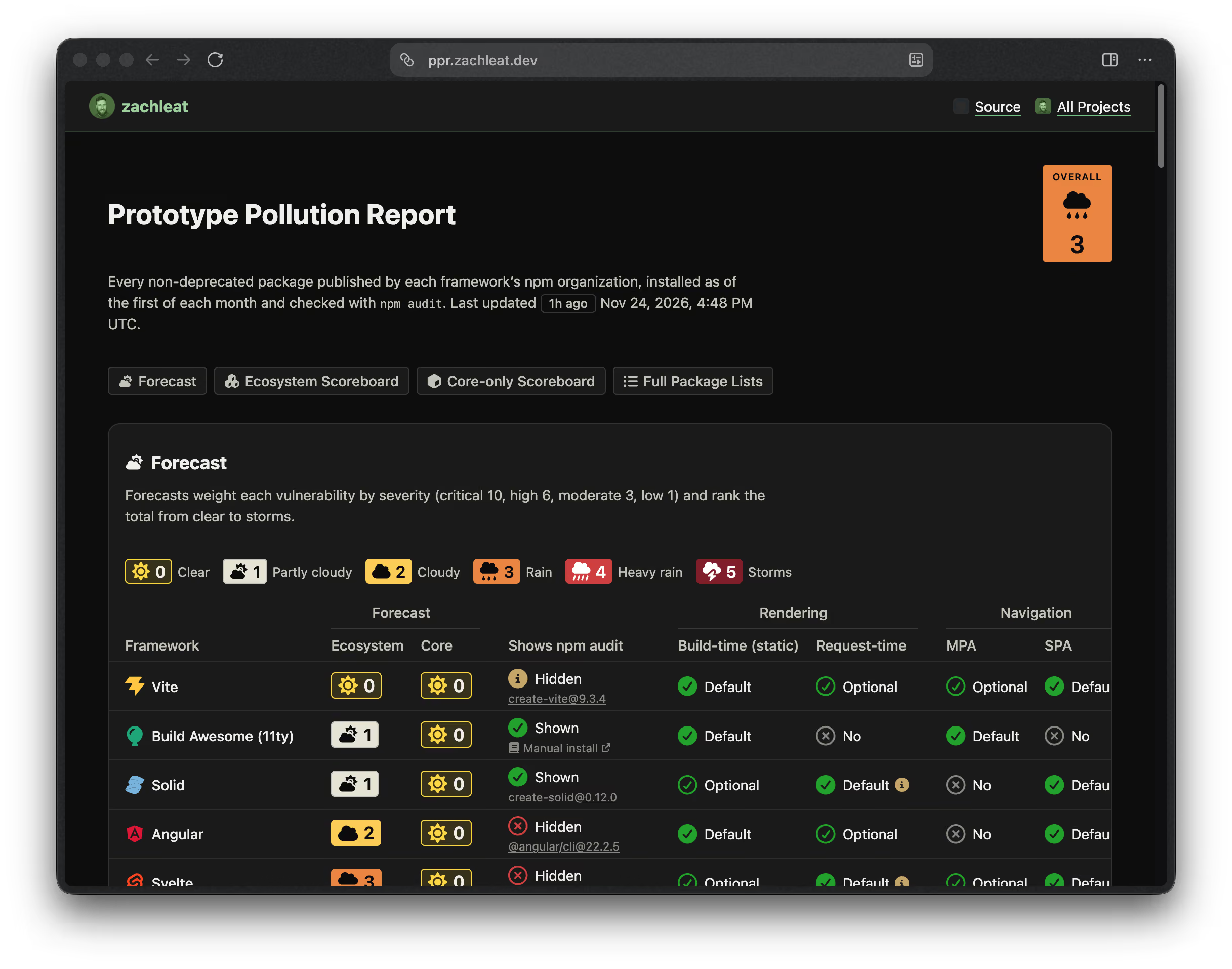
It updates about once a day and will show how different ecosystems measure over time.
- The Ecosystem Scoreboard measures all non-deprecated packages published from various projects and takes a bit of an opinionated stance: maintainers need to deprecate packages they no longer maintain!
- The Core-only Scoreboard measures only the core package, which I felt like was interesting enough to have standalone.
- Full package lists (with audit counts) are shown at the end.
 Poster image by Peter Conrad